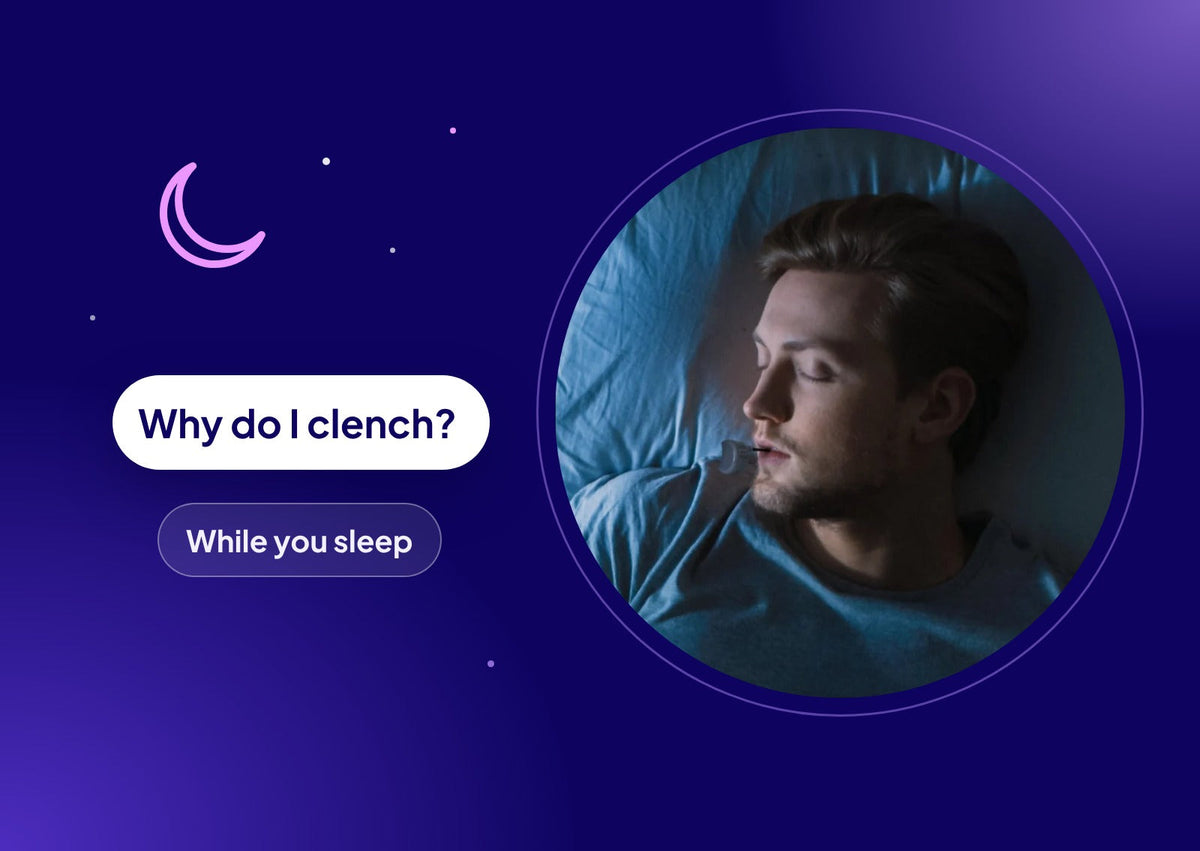
You wake up and your jaw feels like it ran a marathon. Maybe there’s a dull ache at your temples, or your dentist asked if you’ve been under stress lately. You had no idea you were doing anything in your sleep.
Clenching in your sleep is an automatic jaw-muscle activity that happens during brief shifts toward lighter sleep. It’s very common: at least 1 in 10 adults report grinding or clenching at night.
This guide explains what’s going on while you sleep, why some people clench more than others, and what helps.
What’s actually happening while you sleep
Sleep isn’t one flat state. Several times an hour, your body briefly shifts toward lighter sleep for a few seconds. Researchers call these micro-arousals. You don’t wake up, and you won’t remember them.
Most clenching happens right around those moments, usually in the lighter stages of sleep. Sleep researchers have measured the order of events:
What happens in a clench
A few seconds, many times a night
01
Your heart speeds up
Your nervous system shifts gears.
02
Your brain stirs
Activity picks up for a few seconds.
03
Your jaw muscles fire
They tighten or move, sometimes with real force.
The whole thing lasts seconds, and it can repeat many times a night. Some jaw activity during sleep is normal. In one research review, it showed up in about 60% of sleepers who don’t grind at all. In people who clench or grind, it happens more often and with more force.
Why some people clench more than others
There’s rarely one cause. Research points to a handful of things that make clenching more likely:
Why some people clench more
There’s rarely one cause
Stress and anxiety
Alcohol
Caffeine
Smoking
Sleep apnea
Medications, reflux and family history
- Stress and anxiety. A 2020 review found a significant link between stress and bruxism, the clinical name for grinding and clenching. Read more about stress and your jaw.
- Alcohol. It can fragment your sleep, which means more of those lighter-sleep moments.
- Caffeine. Especially later in the day.
- Smoking. Research reviews link all three (alcohol, caffeine and tobacco) to more sleep bruxism.
- Sleep apnea. Sleep apnea and bruxism show up together in a meaningful share of people. If you snore loudly or wake up gasping, mention it to your doctor.
- Medications, reflux and family history. Some medications are linked to clenching. If yours started after a new prescription, talk to your doctor before changing anything.
Often it’s a mix. And sometimes there’s no clear reason at all, which is frustrating and also completely normal.
Clenching vs. grinding: is there a difference?
They’re two forms of the same thing, and many people do both.
Clenching vs. grinding
Two forms of the same thing
| Clenching | Grinding | |
|---|---|---|
| What the jaw does | Squeezes and holds | Slides side to side |
| Sound | Silent | Often audible |
| How people find out | A sore jaw, headaches or a dentist’s comment | A partner hears it |
Because clenching is silent, it tends to go unnoticed longer. Nobody nudges you at 2 a.m. to say you’re squeezing your teeth together.
How to tell if you’re clenching at night
You can’t catch yourself in the act, so look for the evidence in the morning:
Sound familiar?
Look for the evidence in the morning
A tight, tired or sore jaw when you wake up
Dull headaches around your temples
Teeth that feel sensitive, with no obvious reason
Flattened, chipped or worn teeth your dentist or hygienist points out
Ridges along the inside of your cheeks, or scalloped edges on your tongue
Jaw muscles that feel tender when you press on them
When to see a dentist or doctor: if the pain doesn’t ease during the day, your jaw locks or clicks painfully, or someone has noticed loud snoring or pauses in your breathing.
What helps
Since the clench is automatic, the goal is to lower the things that feed it and give your jaw a way to respond differently.
During the day. A relaxed jaw rests with lips together and teeth apart. If you catch yourself clenching at your desk or in traffic, let your teeth separate and drop your shoulders.
Before bed. Keep a steady sleep schedule when you can. Go easy on caffeine after lunch and alcohol close to bedtime, and give yourself a few minutes to wind down.
A night guard. A guard puts a layer between your teeth and absorbs the force, which protects them from wear. It doesn’t change the clenching itself.
Biofeedback. A sensor notices when a clench starts and gives a gentle cue. Your jaw relaxes, usually without you fully waking, and over time it learns to let go on its own. See what the research says.
What helps
What each option does
| Daily habits | Night guard | Biofeedback (Zerene) | |
|---|---|---|---|
| Lowers what feeds clenching | ✓ | ✕ | ✕ |
| Protects your teeth | ✕ | ✓ | ✓ |
| Helps retrain the clench itself | ✕ | ✕ | ✓ |
| Effort each night | Some | Minimal | Minimal |
Where Zerene fits
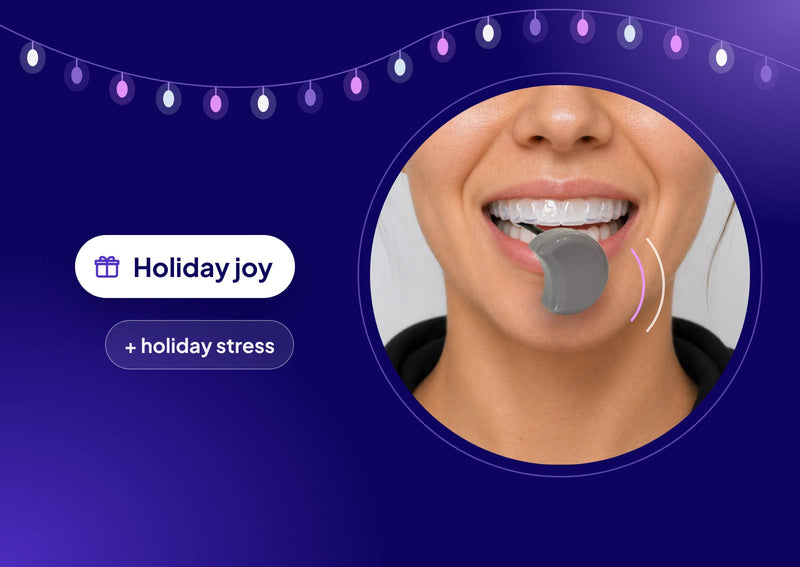
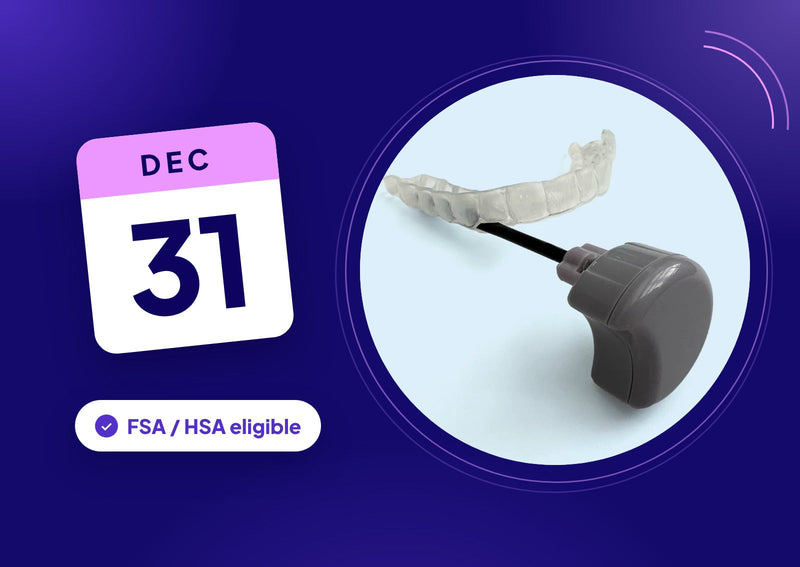
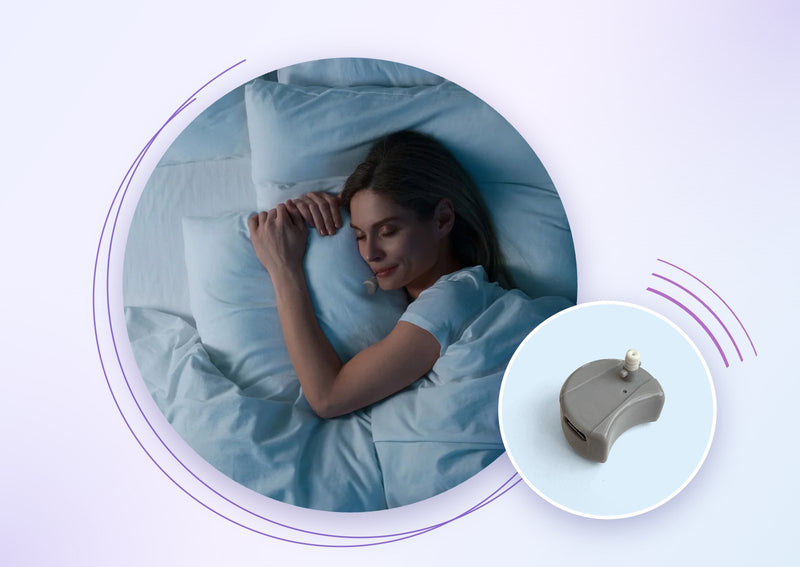
Zerene is a custom-fit smart mouthguard designed for nighttime use. It protects your teeth like a regular night guard, and it adds biofeedback. A small sensor notices when you start to clench and sends a gentle vibration. Your jaw relaxes, and night after night it learns to let go.
Training takes about 2 to 3 weeks, and users have seen up to 90% less grinding. You get a Zerene coach (a real person, not AI) and a nightly report in the app, so you can finally see what your jaw has been doing while you sleep. No prescription or dental appointment needed: you take your impressions at home.
One more thing people tell us: after wearing Zerene at night, they start noticing their daytime clenching too, even when they aren’t wearing it. Once your jaw knows what “relaxed” feels like, it’s easier to catch the opposite.
In real life
★★★★★
“My bruxism has improved by 93% and I can open my mouth wider than I’ve been able to in over 20 years! The coaches are truly excellent.”
Heidi
Not sure if it’s right for you? The fit check takes about a minute, and every order is backed by a 100% money-back guarantee.
FAQ
Why do I clench my jaw when I sleep?
Clenching during sleep is an automatic muscle activity tied to brief shifts toward lighter sleep. Your heart rate and brain activity rise for a few seconds, and your jaw muscles tighten. Stress, alcohol, caffeine, smoking and sleep-breathing problems are all linked to more of it.
Is clenching your jaw in your sleep bad?
Occasional clenching is common and often harmless. Frequent, forceful clenching can lead to sore jaw muscles, headaches, and worn or cracked teeth over time. If you have symptoms, it’s worth bringing up with your dentist.
Can you stop clenching your jaw in your sleep?
You can’t stop it by deciding to, because it starts while you’re asleep. You can lower the things that feed it (stress, late caffeine, alcohol), protect your teeth with a guard, and use biofeedback to help retrain the habit.
Is jaw clenching at night caused by stress?
Stress is one of the factors most often linked to it, though researchers say stronger studies are still needed. It’s usually one of several factors.
Does a night guard stop clenching?
A night guard protects your teeth from the force of clenching. It doesn’t reduce the clenching itself. See how the options compare.
You can’t control your jaw at 3 a.m. You can teach it.
Nighttime clenching happens while you’re asleep, so you can’t sense it or control it on your own, which is why it’s so frustrating. The good news is that your jaw can learn. Take care of the things you can during the day, and give your jaw a gentle cue at night.
Give your jaw a gentle cue
Is Zerene right for you?
Answer a few quick questions to see if you’re a good fit.
Take the 1-minute fit checkReady now? Get Zerene
100% money-back guarantee · Eligible for FSA/HSA reimbursement · No prescription or appointment needed
Keep reading
Sources
- Understanding the clinical management of co-occurring sleep-related bruxism and obstructive sleep apnea in adults, 2025
- Lavigne et al., Neurobiological mechanisms involved in sleep bruxism
- Sleep bruxism mechanisms and micro-arousals (review summary)
- Bertazzo-Silveira et al., sleep bruxism and alcohol, caffeine, tobacco (JADA 2016, summary)
- Sleep Apnea-Hypopnea Syndrome and Sleep Bruxism: A Systematic Review, 2023
- Chemelo et al., Is There Association Between Stress and Bruxism? Frontiers in Neurology, 2020