A Note from Zerene founder Arash Sabet
People often ask me how Zerene Inc. got started. The answer is much simpler than most people expect—it began because I was trying to solve my own bruxism.
At the time, I wasn't thinking about building a company or creating a product for other people. I was simply looking for a solution that made sense to me. Like many people with bruxism, I wanted relief, but I also wanted to understand what was happening. As I learned more about the condition, I realized that most of the available treatments were designed to manage the consequences of bruxism rather than address the behavior itself.
Mouthguards, for example, do an excellent job protecting your teeth, and they are an important part of treatment for many people. But I found myself asking a different question. Instead of wondering how I could better protect myself from grinding, I wondered whether it might actually be possible to reduce the grinding itself.
That question stayed with me.
The idea of simply managing bruxism every night for the rest of my life didn't feel particularly satisfying. I wasn't looking for a miracle cure, and I wasn't expecting an easy answer. But if there was even a possibility that the behavior could change, I felt it was worth exploring.
That curiosity led me to biofeedback.
My background is in biomedical engineering, so I naturally approached the problem from an engineering perspective. One of the things I've always found fascinating is the remarkable ability of the human nervous system to adapt. Throughout our lives we learn new skills, develop habits, and sometimes replace old behaviors with new ones. It made me wonder whether nighttime clenching and grinding might also be influenced by that same capacity to learn.
Biofeedback appealed to me because it aligned with that way of thinking. The concept is straightforward: detect a behavior as it happens, provide immediate feedback, and allow the brain to gradually form new associations over time. It wasn't about forcing change overnight. It was about giving the nervous system an opportunity to recognize a behavior that normally happens outside of conscious awareness and, over time, perhaps respond differently.
I didn't know whether it would work for bruxism, but I believed it was a question worth answering.
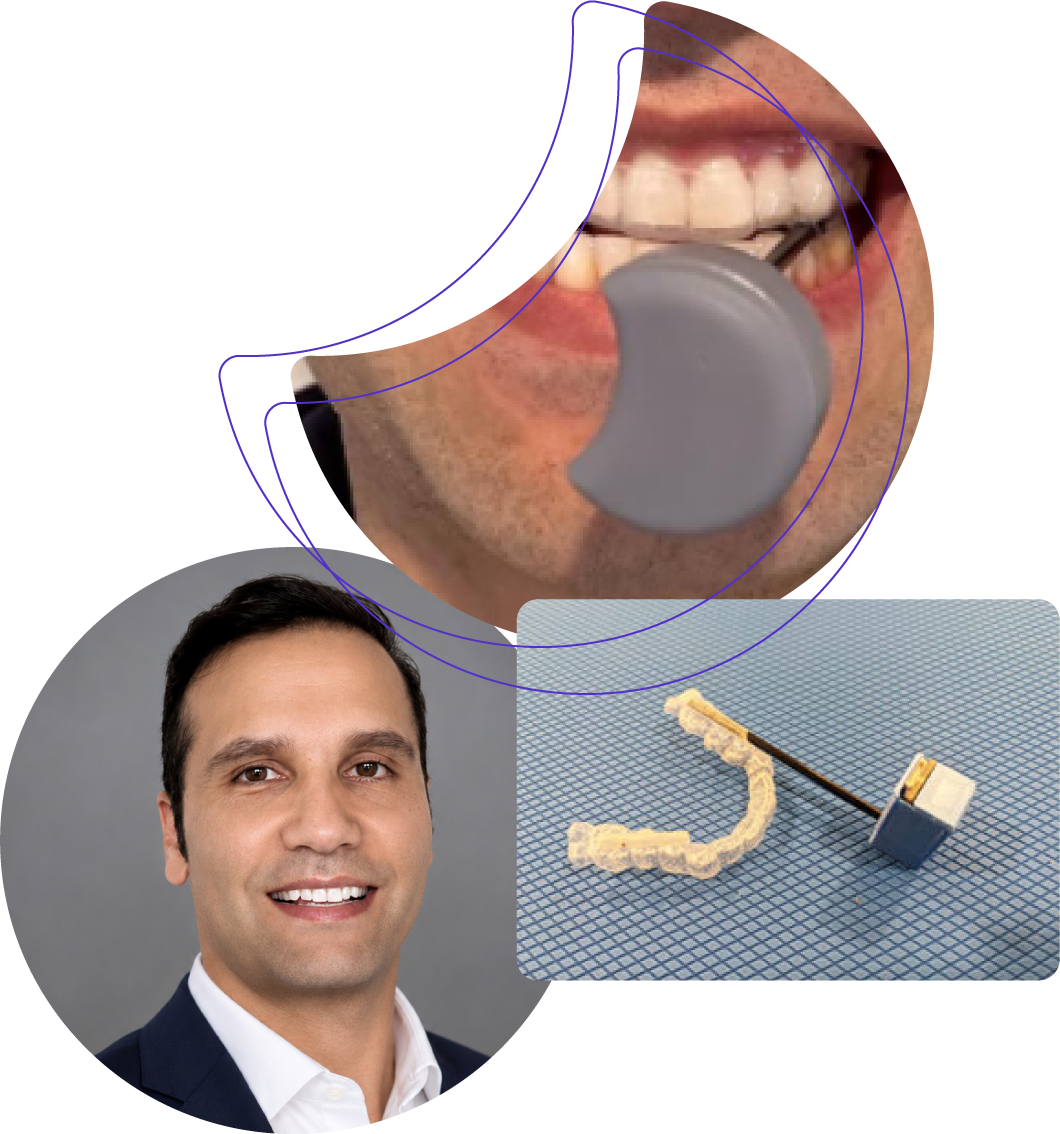
Fortunately, I had the engineering background to build a prototype and test the idea myself. At first, it was nothing more than a personal experiment. I wasn't trying to invent a commercial product. I simply wanted to answer two questions: Could biofeedback help reduce my own bruxism? And if it could, would I be able to measure that change objectively?
That second question mattered just as much as the first.
It's surprisingly easy to convince yourself that something is working because you want it to. I didn't want to rely on assumptions or wishful thinking. I wanted evidence. If I was going to invest months—or even years—into changing a deeply ingrained behavior, I wanted to know whether I was actually making progress.
One of the reasons I believed the timing was right for this approach is that the technology available today is dramatically different from what existed even a decade ago. Biofeedback itself isn't new, but modern electronics have transformed what's possible. Tiny sensors, low-power electronics, smartphones, and cloud computing now allow us to build systems that are smaller, more comfortable, and capable of collecting meaningful data night after night.
For me, that combination was incredibly compelling. Instead of relying solely on how I felt, I could look at objective measurements, identify patterns over time, and evaluate whether the approach was making a real difference. As an engineer, that ability to close the loop—to detect a behavior, provide feedback, and then measure the outcome—felt like a fundamentally better way to approach the problem.
There was also a very personal reason biofeedback resonated with me.
Some people are incredibly disciplined about maintaining lifelong routines. If wearing a mouthguard every night works well for them, that's wonderful. I know myself well enough to recognize that I'm motivated a little differently. I'm happy to work hard toward a goal if I believe it can produce lasting change. Spending months, or even a few years, trying to retrain a deeply ingrained behavior seemed like a worthwhile investment if the benefits could continue for decades.
That's one of the things that attracted me to biofeedback. The goal wasn't to create another product someone would need forever. The goal was to explore whether the body could learn something new.
Another aspect I appreciated was that biofeedback is completely drug-free. The more I've learned about human physiology, the more respect I've developed for just how interconnected the body really is. Medications play an essential role in healthcare, but whenever possible I prefer approaches that work alongside the body's own natural ability to adapt and learn. Biofeedback fit that philosophy perfectly.
For a long time, Zerene remained nothing more than a personal project.
I wasn't thinking about a company. I wasn't thinking about customers. I was trying to answer a question that mattered deeply to me.
As I continued collecting data, however, something changed. I began seeing measurable improvements that gave me confidence I wasn't simply imagining the results. The data aligned with what I was experiencing, and for the first time I felt I had objective evidence that the approach was making a meaningful difference.
That was the turning point.
Once I believed the concept had real potential, I started thinking about everyone else quietly living with bruxism. It's an incredibly common condition, yet it's rarely talked about outside the dentist's office. Millions of people wake up with jaw pain, headaches, worn teeth, or broken restorations and simply assume it's something they'll have to manage indefinitely.
I remembered feeling exactly the same way.
Looking back, it's funny how small the original goal really was. I wasn't trying to build Zerene. I was simply trying to solve my own problem.
What began as a personal experiment eventually grew into something much bigger than I ever expected. Along the way, I realized I wasn't alone. Millions of people quietly live with bruxism, often assuming that managing it is the only realistic option.
I don't believe every case can be solved the same way, and I certainly don't claim to have all the answers. Bruxism is a complex condition, and there's still much we have to learn. But I do believe it's worth asking a different question: what if, instead of focusing only on protecting against the effects of bruxism, we also explored ways to help people change the behavior itself?
That question changed the direction of my life. It led to years of research, countless prototypes, long nights of testing, and ultimately, Zerene.
My hope is that by sharing both my journey and the technology we've developed, others will feel the same sense of possibility that inspired me from the beginning. If Zerene can help someone move beyond simply managing their bruxism and toward creating lasting change, then the journey that started as a personal experiment will have been well worth it.