Sleep & Wellness Magazine
Scott Parker DDS, Arash Sabet, Stephen Sulack
Q1 2026
Abstract
Sleep bruxism (SB) is a common sleep-related movement disorder associated with dental damage, pain, headaches, reduced sleep quality, and significant productivity costs.
This case describes a patient with moderate-to-severe SB who achieved meaningful reductions in bruxism events, pain, and headache frequency after 10 weeks of nightly use of the Zerene biofeedback mouthpiece. Zerene detects clenching in real time and delivers gentle vibratory feedback to promote subconscious relaxation.
Outcomes compare favorably with traditional therapies and highlight the advantages of biofeedback-based behavioral reprogramming.
Introduction
Background and Comorbidities of Bruxism
Sleep bruxism is defined as repetitive jaw-muscle activity characterized by clenching or grinding of the teeth and/or bracing or thrusting of the mandible during sleep(1).
Prevalence in adults ranges from 8–31%, with the highest rates in younger age groups.(3) SB is strongly associated with Temporomandibular disorders (TMD) and myofascial pain,(4) morning tension-type headaches and migraine exacerbation,(5,6) Tooth wear, fractures, cracked restorations, and periodontal damage,(7) Masseter/temporalis hypertrophy and chronic orofacial pain,(8) Sleep fragmentation and non-restorative sleep,(9) Increased risk or co-presentation with obstructive sleep apnea,(10) Higher levels of anxiety, stress, and somatization.(11)
Socioeconomic Impact
Annual U.S. direct and indirect costs attributable to bruxism and its sequelae exceed $1.2–2 billion, driven primarily by dental repairs, TMD management, headache-related absenteeism, and reduced workplace productivity.(12,13) Patients with chronic SB report 2–5 lost workdays per year on average due to pain and fatigue.(14)
Treatment Options
Current evidence-based management of sleep bruxism includes occlusal splints/night guards, which protect teeth and reduce EMG activity by 30–50% but do not address underlying motor behavior and have low long-term compliance;(15,16) pharmacotherapy (e.g., cyclobenzaprine, clonazepam, clonidine), which reduces RMMA by 30–60% short-term but carries risks of sedation, dependency, and rebound;(17) and botulinum toxin injections into the masseter/temporalis, which reduce muscle force and pain in 60–80% of patients for 3–6 months but are costly, require repeat treatment, and do not address the central pattern generator.(18) Behavioral approaches (cognitive-behavioral therapy, stress management, sleep hygiene) may benefit mild or stress-related awake bruxism but have limited efficacy for moderate–severe sleep bruxism alone.(19) Mandibular advancement devices, primarily indicated for co-existing OSA, may reduce SB in some patients but can worsen it in others.(20) Physiotherapy, massage, and dry needling address secondary myofascial pain but have limited impact on nocturnal events.(21) Consultation with a dental TMJ/orofacial pain specialist is recommended for moderate–severe or chronic cases to evaluate intra-articular pathology, perform advanced diagnostics (CBCT, MRI, mounted casts), coordinate multidisciplinary care, and assess candidacy for advanced interventions (arthrocentesis, arthroscopy, joint replacement in refractory cases).
Biofeedback-based approaches, including the Zerene device, provide a non-invasive, drug-free, home-use alternative that directly targets and reprograms subconscious motor behavior rather than merely protecting teeth or temporarily weakening muscles.(22,23)
Zerene Device Overview
System Architecture and Operational Logic
The Zerene system is a hybrid intraoral-extraoral biofeedback device designed to mitigate bruxism through behavioral modification.
The device operates in two modes:
Study Mode
Passive baseline monitoring without intervention.
Training Mode
Active intervention mode in which real-time bruxing detection triggers haptic vibratory feedback intended to interrupt the behavior.
Mechanical Design and Data Acquisition
The patient interface is a ~1 mm soft occlusal guard with a unilateral lumen spanning the premolars to first molar, housing a pressure tube connected to an extraoral module that detects and logs pressure increases during bruxing events and, when enabled, delivers haptic feedback via the tube to perioral tissues; the system also captures multisensory data (orientation, temperature, acoustics, light) and, while primarily enabling behavioral interruption, functions as a dental splint for secondary occlusal protection.

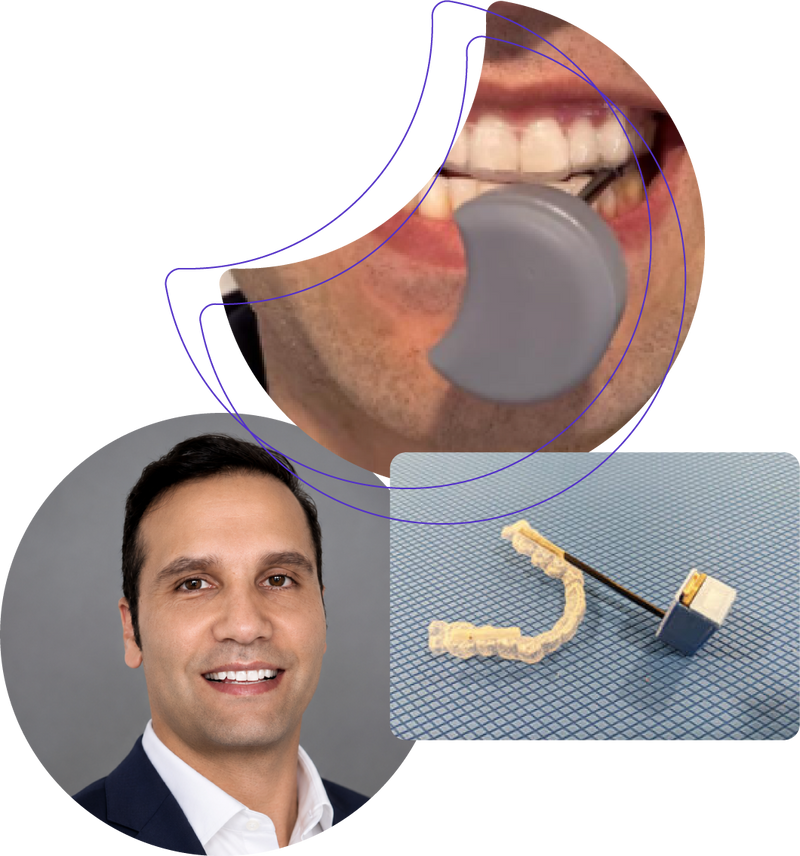
Figure 1: Zerene module and custom mouthguard. The Zerene device combines an occlusal splint with an electronics module.

Figure 2: Zerene in use. The intraoral-extraoral topology reduces intraoral size and keeps electronics strictly out of the buccal cavity.
Patient History and Clinical Background
The subject, a medical student with a 10-year history of bruxism-related morning headaches, had used occlusal splints for >7 years (hard and soft) with only marginal dental protection and no headache relief, and expressed preference for targeting the underlying neuromuscular activity over long-term pharmacologic management; although only the first 100 daily sessions are shown, regular use exceeded 8 months at time of publication.
Methodology: Baseline and Intervention
The study used a two-phase protocol for comparison. During the baseline phase (7 nights), the subject used the Zerene device in Study Mode to monitor activity without triggering feedback. This was followed by the training phase (>10 weeks), in which the device was switched to Training Mode, detecting pressure increases in the occlusal lumen and delivering immediate haptic vibrations to interrupt bruxing events.
Quantitative Results: Objective Data and Behavioral Modification
The Z-Score™: Impact on Time-Averaged Bruxing Activity
The primary outcome was the Z-Score,™ a time-averaged composite of bruxing frequency and event magnitude (force) over total sleep duration. Following initiation of active biofeedback, the Z-Score™ showed a sustained reduction of >95% relative to baseline (Figure 1), indicating near elimination of cumulative bruxing load and substantial reduction in masseter and temporalis muscle activity. Around night 89 (Figure 3), a single no-feedback session produced scores consistent with adjacent training sessions, suggesting a retained behavioral effect.

Figure 3: Longitudinal Analysis of Clinical Efficacy and Behavioral Response. Figure tracks the time-averaged Z-Score™, demonstrating a 95% reduction from the passive Study Phase (blue) through the 10-week Training Phase (green) that maintained out past 100 sessions.
Activity Characterization: Evidence of Behavioral Learning
The Z-Score™ is composed of bite frequency and bite strength, both of which reflect unconscious nocturnal activity and are shown separately in Figure 4. Over the 10-week period, bites per hour decreased steadily—with some periodic variation—eventually stabilizing at approximately one-quarter of baseline levels, while bite effort showed a similar downward trend. Notably, strong bite events disappeared during training and did not reappear during the no-feedback session, suggesting a behavioral learning effect. The absence of device cues during that session indicates that the central nervous system had adapted, either preemptively responding to prior biofeedback or conditioning to avoid the activation threshold.

Figure 4: Z-Score™ Component Separation. The top axis shows the bite effort in different strength regimes, quantified by the pressure detected from the device. Bites above 15 kPa (bite_effort_15K) represent strong muscle effort, 10 kPa moderate, and 5 kPa milder. The bottom axis shows the total number of bites recorded and averaged over the number of hours the session was run for. Both components of the Z-Score™ decreased steadily during this observation period.
Bite Characterization: Intervention Customization
The Zerene sensor suite enables individualized programs by capturing detailed pressure data to characterize bite signatures (e.g., biting, grinding, clenching). Data quality is enhanced using environmental inputs (e.g., temperature, light) to isolate sleep periods, while device pose helps assess restlessness and behavioral changes, improving overall interpretation.

Figure 5: Pressure Response Comparison First Study to Last Training. This graph compares the pressure (pascals) recorded during the first study session for the user and the last training session over the full elapsed time of the session. The gray zone is plotted in the right figure to show the activation region for biofeedback. It can be seen that training has greatly reduced, by about 4x, the biting strength. The small amount of activity in the activation region is also indicative of bite behavior modification.
Qualitative Outcomes and Patient Subjective Reports
The patient reported a marked reduction in headache frequency and severity (~50%), with noticeable improvement within 14 days that persisted throughout the 10-week period. The ~1 mm soft occlusal guard was highly tolerable and preferred over standard guards. Prior use of Clench Alert was intolerable, whereas Zerene’s extraoral electronics and tube-based haptic feedback supported consistent nightly use. Despite a demanding schedule, device integration was seamless, with the mobile application enabling progress tracking and visualization.
Discussion: Sleep Architecture and Compliance
Biofeedback was associated with improved sleep quality, as reductions in morning headaches and Motor Duty suggest enhanced restorative sleep despite initial concerns about haptic disruption. With conditioning, the intervention became less intrusive, reducing potential micro-arousals. Compliance observations included occasional unconscious removal during early adaptation, while consistent biofeedback reduced wear on the lumen and extended device lifespan. Psychologically, the subject reported strong trust in the device and reluctance to discontinue use due to concern about reverting to symptom-based treatment.
Conclusion
The Zerene device transitioned the patient from passive dental protection to active behavioral modification, achieving a 95% reduction in Z-Score™, ~50% reduction in pain, and decreased bite frequency and strength, supporting pneumatic-haptic biofeedback as a viable non-pharmacologic approach to treating the neuromuscular source of bruxism rather than only protecting against its effects.
References
- Lobbezoo F, Ahlberg J, Raphael KG, et al. J Oral Rehabil. 2018;45(11):837–844. doi:10.1111/joor.12663. PMID: 29952031.
- Manfredini D, Bracci A, Lobbezoo F. J Oral Rehabil. 2023;50(1):29–38. doi:10.1111/joor.13395. PMID: 36385462.
- Melo G, Pauletto P, Duarte J, et al. J Oral Rehabil. 2019;46(11):1063–1071. doi:10.1111/joor.13200. PMID: 31254399.
- Jiménez-Silva A, Tobar-Reyes J, Vivanco-Coke S, et al. Cranio. 2017;35(1):1–11. doi:10.1080/08869634.2016.1207091. PMID: 27400439.
- Fernandes G, Franco AL, Gonçalves DA, et al. J Headache Pain. 2017;18(1):100. doi:10.1186/s10194-017-0805-3. PMID: 28971371.
- Kuang Y, Li L, Shi J, Li B. Headache. 2023;63(6):769–779. doi:10.1111/head.14530. PMID: 37140015.
- Lavigne GJ, Khoury S, Abe S, et al. J Oral Rehabil. 2008;35(7):476–494. doi:10.1111/j.1365-2842.2008.01881.x. PMID: 18557904.
- Klasser GD, Manfredini D. J Oral Rehabil. 2015;42(4):301–311.
- Martynowicz H, Gac P, Brzecka A, et al. Sleep Med Rev. 2019;48:101215. doi:10.1016/j.smrv.2019.101215. PMID: 31654747.
- Tan MWY, Yap AUJ. Sleep Med Rev. 2023;69:101764. doi:10.1016/j.smrv.2023.101764. PMID: 36921476.
- Cavallo P, Carpinelli L, Savarese G. Front Neurol. 2022;13:946076. doi:10.3389/fneur.2022.946076. PMID: 36090872.
- Riley JL 3rd, Benson MB, Gordan VV, et al. J Public Health Dent. 2021;81(1):49–58. doi:10.1111/jphd.12404. PMID: 33037664.
- List T, Axelsson S. J Orofac Pain. 2007;21(2):105–114.
- Dahlström L, Carlsson GE. Acta Odontol Scand. 2015;73(8):604–610.
- Alqutaibi AY, Aboalrejal AN, Alqahtani SM. StatPearls. 2024.
- Klasser GD, Manfredini D, Goulet JP, et al. J Oral Rehabil. 2020;47(3):397–411. doi:10.1111/joor.12926. PMID: 31830360.
- Huynh NT, Rompré PH, Montplaisir JY, et al. Sleep. 2006;29(3):307–316. doi:10.1093/sleep/29.3.307. PMID: 16553016.
- Fernández-Núñez T, Amghar-Maach S, Gay-Escoda C. J Clin Med. 2019;8(10):1563. doi:10.3390/jcm8101563. PMID: 31569431.
- Ommerborn MA, Taghavi J, Singh P, et al. Clin Oral Investig. 2019;23(7):2769–2777. doi:10.1007/s00784-018-2719-6. PMID: 30536145.
- Alessandri-Bonetti A, Bortolotti F, Bartolucci ML, et al. Sleep Breath. 2022;26(4):1975–1987. doi:10.1007/s11325-022-02594-6. PMID: 35175558.
- Melchior M, Barros AC, Nunes A. J Oral Rehabil. 2015;42(1):66–77.
- Jadidi F, Castrillon E, Svensson P. J Oral Rehabil. 2008;35(9):653–662. doi:10.1111/j.1365-2842.2008.01877.x. PMID: 18557903.
- Watanabe T, Watanabe T, Kanazawa M. J Prosthodont Res. 2022;66(3):371–382. doi:10.2186/jpr.JPR_D_21_00207. PMID: 35691860.