97% + Reduction in Bruxism is Possible
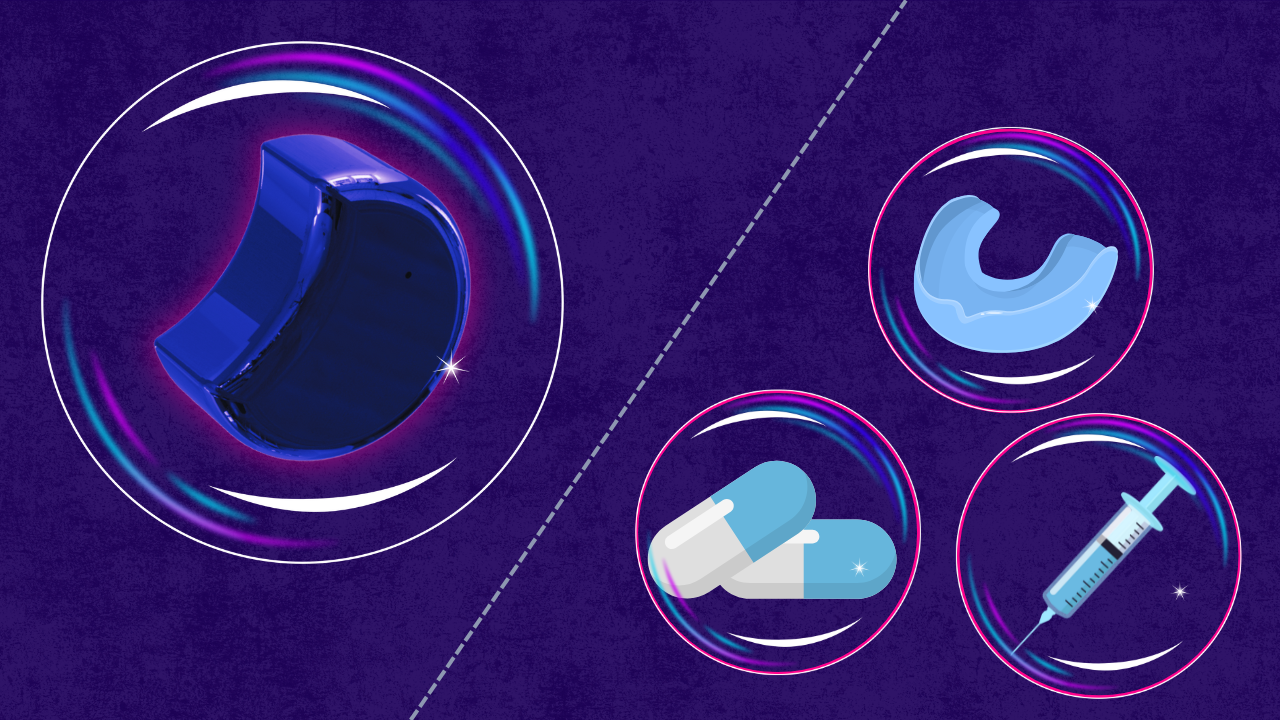
If you grind or clench your teeth at night, you already know how limited the options feel. A night guard protects your teeth, but it doesn’t stop the grinding. Injections may relax the muscle temporarily, but they don’t change the underlying behavior. Unless they find something that ACTUALLY works, most people end up blindly navigating the problem indefinitely.
This post shares the real data from one Zerene user, working in a high stress environment, who completed the Zerene biofeedback training program. Her results were striking: a reduction in bruxism activity of over 97% within approximately 23 nights of use. We’ll walk through what her data shows, why it matters, and what it tells us about how biofeedback can work as a treatment for sleep bruxism.
Background: The Problem With Conventional Treatments:
Sleep bruxism – the involuntary clenching or grinding of teeth during sleep, affects an estimated 8-15% of adults. Though it is common, it remains a frustrating condition to manage. Standard approaches include:
-
- Occlusal splints (night guards): Protect teeth from wear and may reduce jaw muscle tension, but do not address or reduce the grinding behavior itself.
- Botulinum toxin injections: Botox can reduce the force of clenching by weakening the masseter muscle, but effects are temporary (3–6 months) and require repeat treatments. Masseter injections are also known to cause premature facial aging (jowls).
- Stress management / behavioral therapy: Can be helpful, however such treatments are indirect and lack quantitative data to support their effectiveness.
- Cost over time: These symptom management treatments leave Bruxers with a lifetime financial commitment, with no possibility of permanent resolution. Bruxers face a never ending cycle that always ends in the same result…money out of your pocket.
All of these treatments lack an important aspect of Bruxism relief: corrective treatment.
Biofeedback: What is it and how does Zerene use it?
Biofeedback is a signal that helps make people aware of certain behavior. In this case, biofeedback helps Bruxers to become subconsciously aware of the fact that they are grinding their teeth in their sleep, thereby assisting in disrupting that behavior. The benefits of Biofeedback in reducing sleep bruxism has been well documented, but more studies are needed.
Biofeedback creates the opportunity to train the jaw muscles to relax. This is a fundamentally different approach that targets behavior, not just symptoms.
Zerene uses vibratory biofeedback delivered through a wearable mouthguard. When the device detects bite pressure above a set limit, it delivers a subtle signal.
Gentle enough not to wake the user, but sufficient to interrupt the grinding pattern. Over repeated nights, the goal is to recondition the jaw’s behavior at a neuromuscular level.
What is a Z-Score?
Zerene presents bruxism activity to  users using the “Z-Score” — a composite metric that captures the frequency and intensity of teeth-clenching and grinding events during sleep.
 A lower Z-score means less grinding activity. The Z-Score is tracked nightly, giving both the user and the coaching team a clear, objective way to track progress.
Let’s Get Into The User Data:
Here’s What You’ll Learn Next:
- The Zerene User’s Starting Point: Why she started using Zerene
- How the Data was Collected: How Study & Training Modes Create Results
- The Results: How the User saw a 97% reduction in Bruxism activity
The User: Profile & Starting Point
The user in this case study has a high stress job. She had been dealing with nighttime clenching and bruxism for an extended period, and the experience was consistent with what many bruxers report:
- Awareness of the problem, but limited treatment options that actually helped
- Discomfort or intolerance with some existing devices
Her own words describe it well: “I barely notice it now, but wearing my Zerene did take some getting used to… I am excited that at this point the biting and clenching is pretty much gone.”
The Study Protocol: How the Data Was Collected
Zerene’s user-friendly training approach involves two distinct phases, both tracked via the app:
- Study phase (baseline): The device is worn without biofeedback intervention. This establishes the user’s baseline bruxism activity. This data is then used to calibrate the necessary training.
- Training phase: Biofeedback is activated. When the device detects biting or clenching above the individual’s personalized limit, a gentle vibratory signal is delivered. The user’s limit is adjusted over time by Zerene’s coaching team based on their nightly data.
This two-phase design allows for a meaningful before and after comparison within a single user, controlling for the natural variability that makes bruxism difficult to study. The baseline Z-score provides the comparison point against which training results are measured.
The Results: What the Data Showed
Overall Reduction
Over approximately 23 nights of use (including both study and training phases) this user’s bruxism activity was reduced by over 97%. In practical terms: the jaw muscle activation that had been occurring nightly at significant intensity was almost entirely eliminated by the end of the training period.
~ 23
Nights of use (Study and Training)
>97%
Reduction in bruxism activity
The Shape of the Response
What makes the data particularly interesting is not just the final number, but the pattern of change. In the study phase (no biofeedback), Z-scores were consistently high. This was the user’s natural, untreated baseline. When training began, scores began to drop, and continued to decrease over the subsequent training sessions. This is consistent with a learning curve: the jaw muscles gradually recalibrate their nighttime behavior in response to the repeated biofeedback signal.

Determining the Bite Limit:
Throughout the training period, Zerene’s coaching team adjusted the bite sensitivity and vibration strength to maintain an appropriate level of challenge as the user’s behavior improved. This adaptive calibration is an important feature: if the threshold is set too low, the user receives constant disruption; too high, and the biofeedback fails to engage frequently enough to ensure adequate learning opportunities. Since this user responded consistently to the training, the coaches were able to continually lower the bite limit. This development made training increasingly sensitive even to weaker bites.
The device was able to detect and interrupt increasingly subtle grinding events as the more intense clenching was eliminated. Zerene is a treatment that is specifically tailored to your needs.
“The biting and clenching is pretty much gone.”
Zerene Offers Corrective Treatment, not just Symptom Management:
The distinction between treating a symptom and changing an underlying behavior is central to understanding why biofeedback results like this are clinically meaningful.
A night guard reduces the damage caused by grinding — it is protective, not corrective. Botulinum toxin reduces the muscular force but does not eliminate the neurological impulse to grind. Biofeedback, by contrast, targets the behavior itself by introducing a feedback loop that the nervous system can use to learn a new pattern.
In this user’s case, the data suggests that learning did occur – the 97%+ reduction represents not just a reduction in events counted, but a fundamental change in how the jaw was behaving during sleep.
A Customized Approach for Each Bruxer:
Results vary between individuals. Some users see rapid initial reductions; others progress more gradually. Factors such as bruxism severity, stress levels, and adherence to nightly use all play a role. Zerene’s coaching team monitors each user’s data individually and adjusts training parameters accordingly. Each Zerene user is a study of one.
What This Looks Like in Practice
For this particular user, the clinical picture was straightforward: she had a real problem, she tolerated the device well after an initial adjustment period, she wore it consistently, and her bruxism activity responded strongly to the biofeedback training. Her subjective experience matched the objective data — she reported that the clenching felt “pretty much gone,” which aligned with what her Z-scores showed.
This alignment between subjective experience and objective measurement is exactly what the data tracking is designed to provide. For many people, bruxism is an invisible problem that happens during sleep, and they only engage with it through downstream effects like jaw soreness, headaches, or dental damage. The ability to see grinding activity represented as data gives users something concrete to track, which many find motivating and reassuring.
Summary of Key Data Points:
METRIC
FINDING
User demographic
Professional in high stress environment
Total nights of use
~23 nights
Baseline bruxism activity
Consistently high Z-scores prior to Zerene use
Bruxism activity reduction
>97% reduction over the course of Zerene use
Response pattern
Progressive decline over training nights
Threshold adjustment
Adaptive – calibrated downward as behavior improved
User-reported experience
“Biting and clenching is pretty much gone”
Device tolerance
Well tolerated after initial adjustment period
The Bottom Line
The data from this user is a clear illustration of what biofeedback training can achieve. A reduction of over 97% in bruxism activity within approximately 23 nights is not a subtle effect. These numbers highlight a near-complete elimination of the behavior that was causing the problem.
That kind of result doesn’t come from a night guard, and it doesn’t come from a muscle relaxant. It comes from training the jaw to behave differently during sleep — which is exactly what Zerene was designed to do.